
When Is Toughened Glass Required? UK Building Regulations Explained
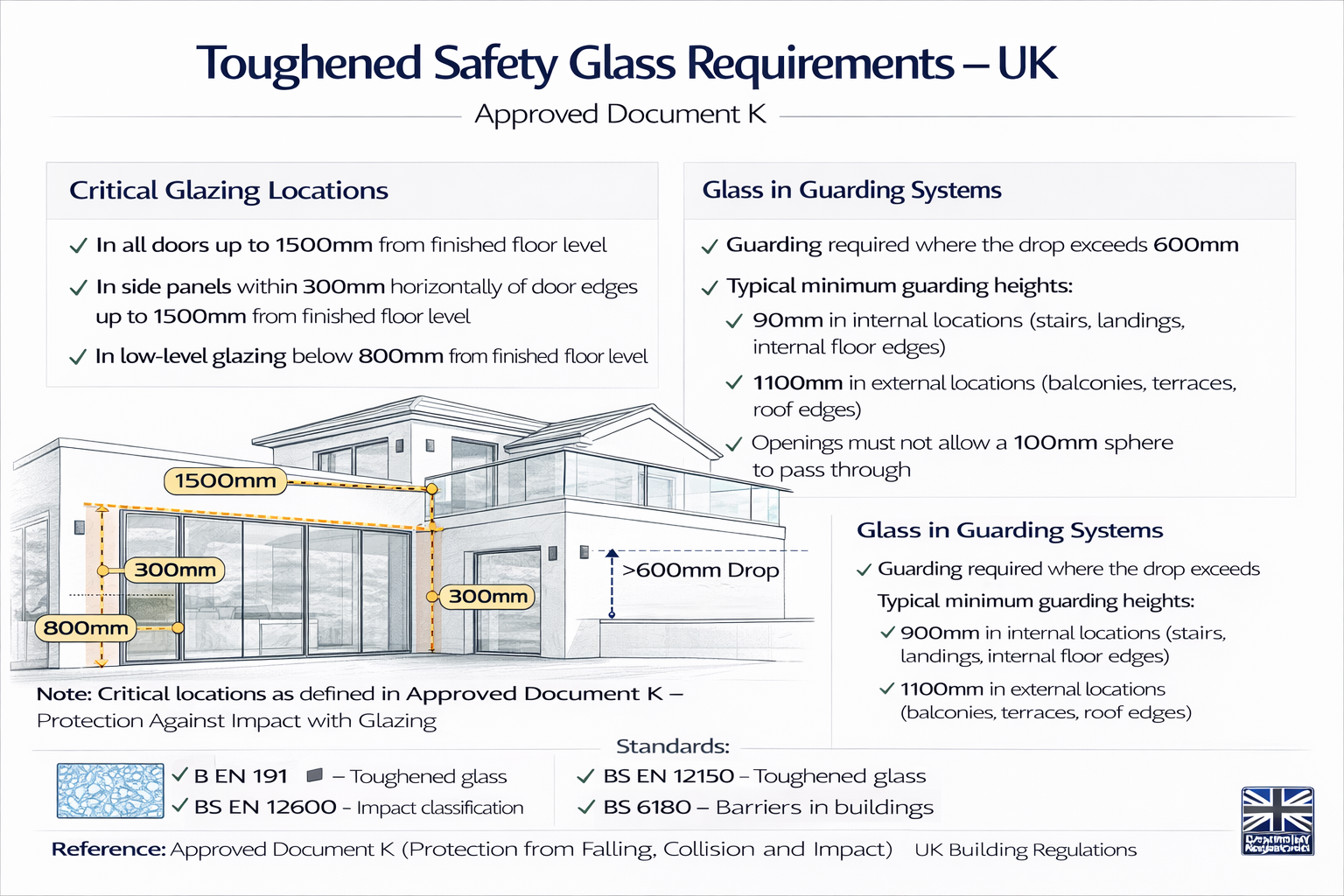
UK toughened glass requirements under Approved Document K, showing critical glazing zones at 1500mm and 800mm, the 300mm horizontal door rule
Toughened Glass in the UK
The Complete Technical Guide to Manufacturing, Regulations, Uses & Compliance
Introduction
Toughened glass is one of the most widely specified safety glazing materials in the UK.
It is used in:
Doors
Windows
Shower screens
Shopfronts
Internal partitions
Glass balustrades
Juliet balconies
Roof terraces
Schools and public buildings
But it is also one of the most misunderstood.
Many people assume:
“Double glazing means toughened.”
“Toughened glass is always compliant.”
“If it’s strong, it must be safe.”
“Toughened and laminated are interchangeable.”
They are not.
This guide explains, clearly and precisely:
How toughened glass is manufactured
What BS EN 12150 actually covers
What BS EN 12600 impact classifications mean
Where Approved Document K requires safety glazing
When laminated glass is required instead
How guarding and fall protection differ from impact safety
What UKCA / CE marking proves
How Building Control interprets compliance
Common specification failures
Real-world professional guidance
This document is structured so that:
Architects can reference it
Building Control would not dispute it
Glazing professionals will respect it
Homeowners can understand it
1. What Is Toughened Glass?
Toughened glass (thermally tempered glass) is soda-lime silicate glass that has been heat-treated to increase its strength and alter its breakage behaviour.
It is governed in England by:
Approved Document K – Protection from Falling, Collision and Impact
BS EN 12150 – Thermally Toughened Safety Glass
BS EN 12600 – Pendulum Impact Test
BS EN 14449 – Laminated Safety Glass (when laminated is used)
Toughened glass is:
Approximately 4–5 times stronger in bending than annealed glass
More resistant to thermal stress
Designed to fragment into small granular pieces when broken
Its purpose is impact safety.
It is not automatically a fall-protection solution.
That distinction is critical.
2. How Toughened Glass Is Manufactured
Understanding the process explains its behaviour.
Step 1 – Cutting & Processing (While Annealed)
All cutting, drilling, polishing and shaping must be completed before toughening.
After tempering, the glass cannot be altered.
Attempting to cut toughened glass will cause immediate failure.
Step 2 – Washing & Inspection
The glass is cleaned and inspected for:
Edge defects
Surface contamination
Inclusions
Surface damage
Step 3 – Furnace Heating
The glass is heated to approximately 620°C in a tempering furnace.
Step 4 – Rapid Air Quenching
High-pressure air rapidly cools the surfaces.
This creates:
Surface compression
Internal tensile stress
This stress profile increases strength but causes full fragmentation if broken.
Q&A – Manufacturing
Q: Why does toughened glass sometimes “explode” spontaneously?
Rare nickel sulphide inclusions can expand over time and trigger breakage. Heat soak testing reduces risk but is not mandatory under Building Regulations.
Q: Can toughened glass be drilled later?
No. All processing must occur before tempering.
Q: Is toughened glass bulletproof?
No. It is stronger than annealed glass but not ballistic-resistant.
3. The Legal Framework in England
Approved Document K addresses two separate risks:
Injury from impact
Falls from height
These are distinct compliance issues.
Many specification mistakes occur because they are treated as the same problem.
They are not.
4. Impact Safety – Critical Locations
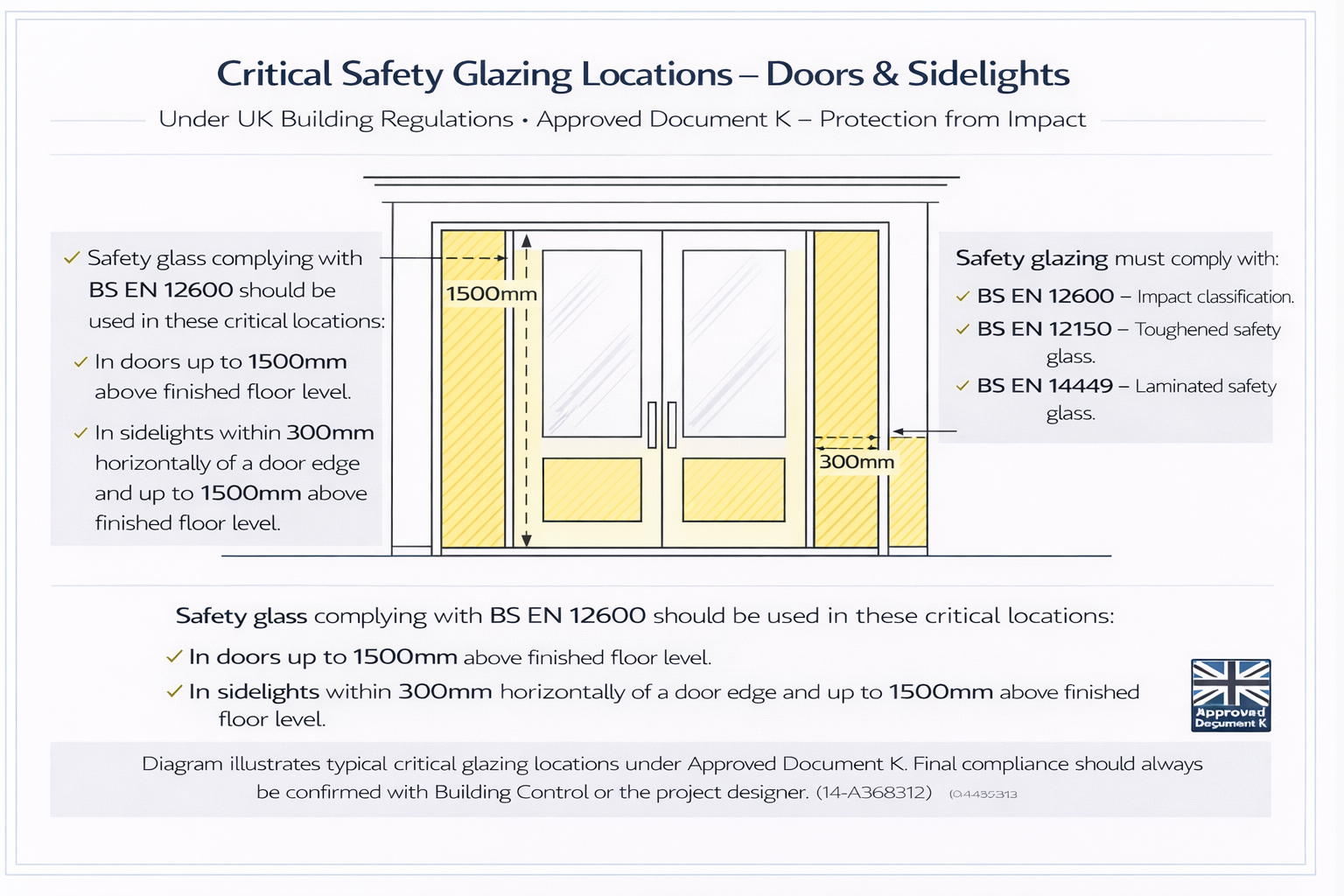
Infographic explaining UK toughened glass requirements for doors and adjacent sidelights under Approved Document K showing 1500mm from finished floor level and 300mm horizontal critical location rule.
Safety glazing is required in defined “critical locations”.
These include:
A) Glazing in Doors
Up to 1500mm above finished floor level.
B) Glazing Beside Doors
Within 300mm horizontally from the door edge and up to 1500mm high.
C) Low-Level Glazing
Any glazing below 800mm above finished floor level.
These 800mm / 1500mm / 300mm thresholds are fixed regulatory triggers.
If glazing falls within these zones, it must be safety glass.
This is not optional.
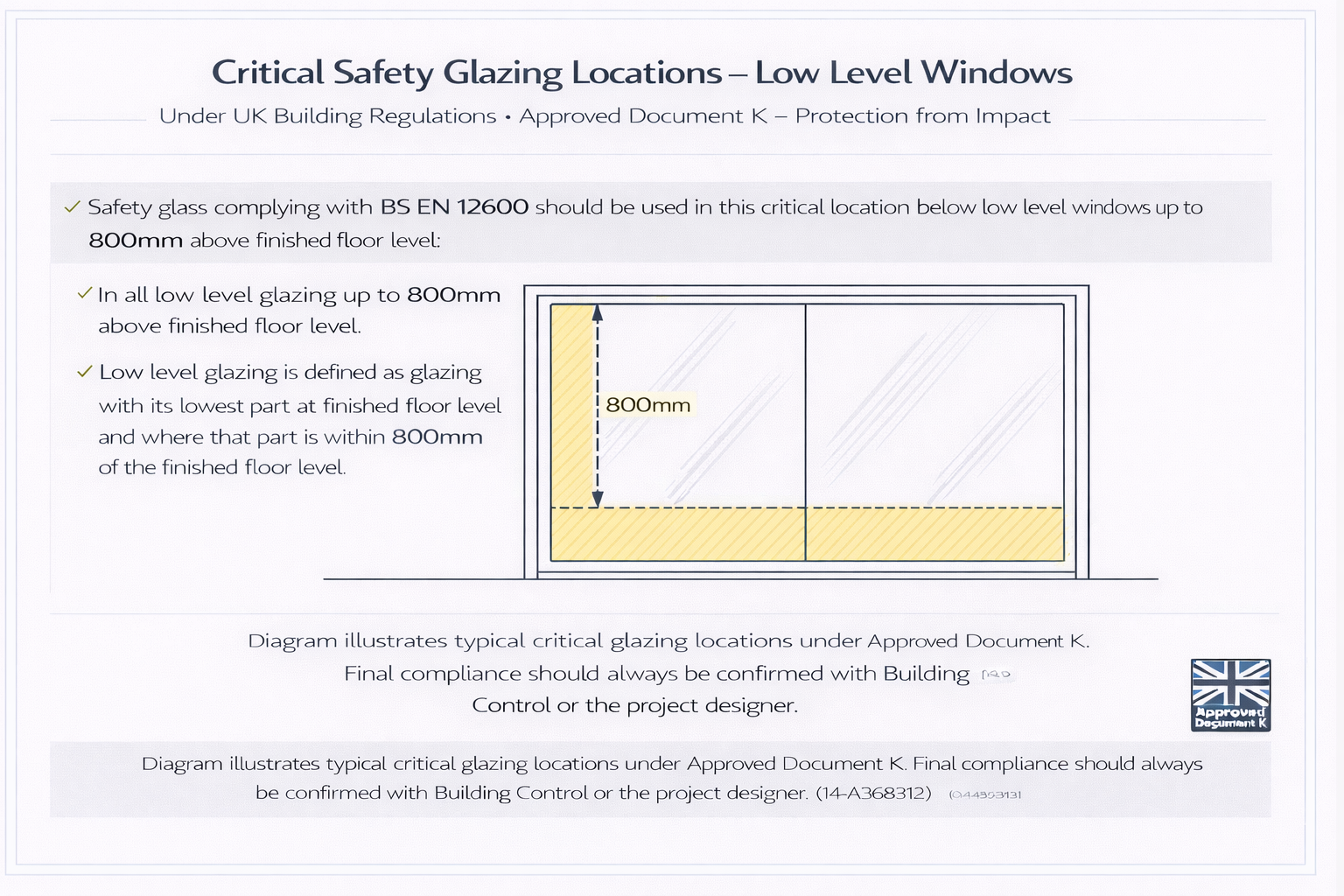
Diagram showing critical safety glazing locations for low-level windows under UK Building Regulations Approved Document K. Safety glass complying with BS EN 12600 required in glazing where the lowest part of the glass is at floor level and any part of the glazing is within 800 mm above the finished floor level.
Q&A – Critical Locations
Q: If a window starts at 790mm from the floor, does it require safety glass?
Yes. Below 800mm is a critical location.
Q: Does double glazing automatically mean toughened glass?
No. It must be specified.
Q: Does replacement glazing have to comply?
Yes. Replacement glass must meet current safety standards.
5. BS EN 12600 – The Pendulum Impact Test
Approved Document K uses BS EN 12600 to define acceptable impact behaviour.
The classification format appears as:
1(B)1
2(B)2
3(C)3
For domestic critical locations:
Class 3 is generally acceptable
Class 2 is required where pane width exceeds 900mm in doors or side panels
EN 12150 confirms the product is toughened.
EN 12600 confirms how it behaves under impact.
They are not the same standard.
Q&A – Impact Classification
Q: Does EN 12150 automatically mean it passes EN 12600?
No. Impact classification must be confirmed separately.
Q: What evidence does Building Control expect?
Manufacturer test data or Declaration of Performance.
6. Guarding & Fall Protection
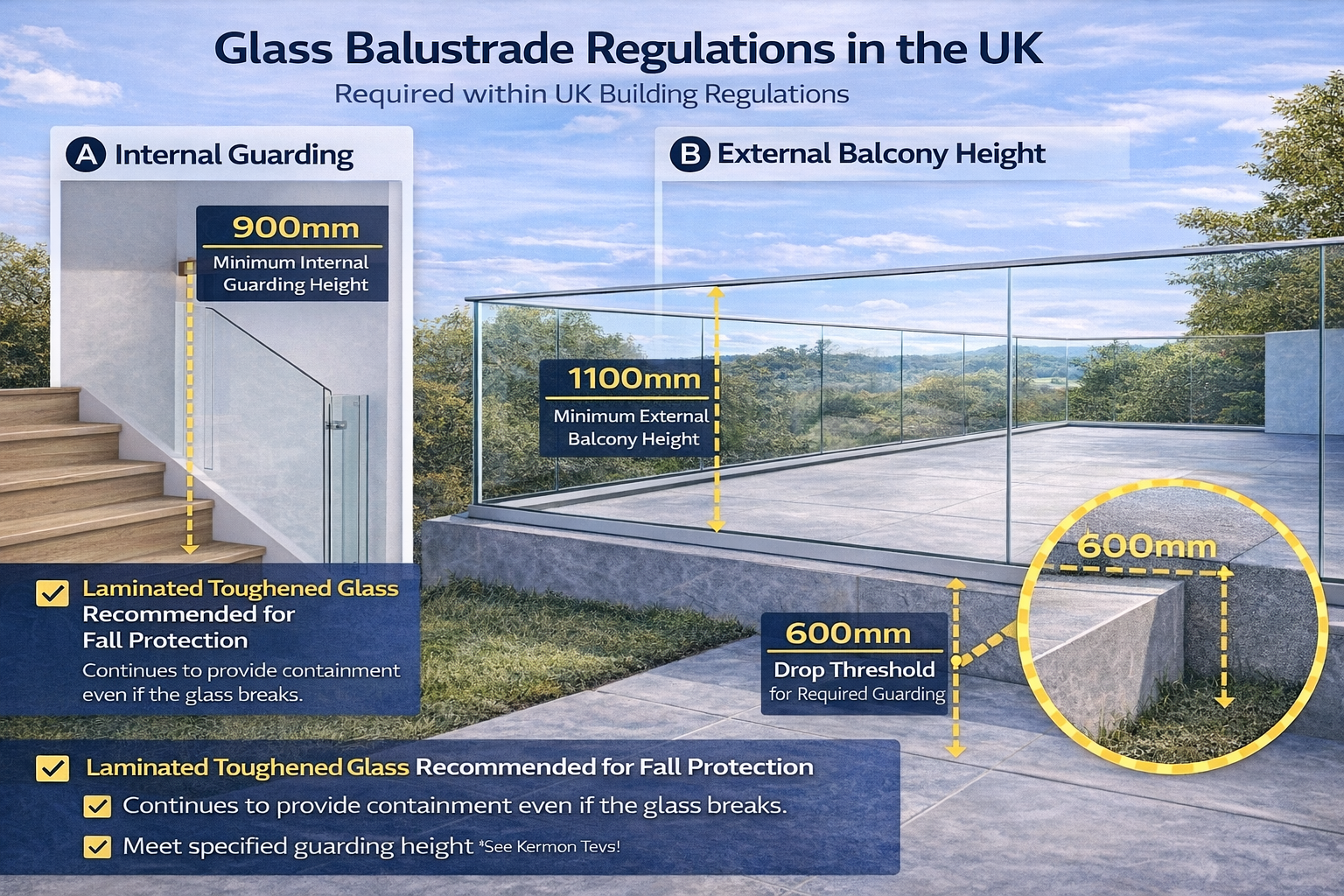
UK glass balustrade regulations under Approved Document K highlighting 900mm internal guarding height, 1100mm external balcony height and the 600mm drop threshold requiring guarding.
Guarding is required where there is a drop greater than 600mm.
Typical domestic guarding heights:
900mm internal
1100mm external
Now the important distinction:
If glass is acting as a barrier — such as in:
Balustrades
Juliet balconies
Roof terraces
Lightwells
Stair edges
The issue is no longer just impact safety.
The issue is fall protection.
7. Toughened vs Laminated in Guarding Applications
When glass is acting as guarding, the key question is:
What happens if it breaks?
Toughened Glass in Guarding
Toughened glass:
Breaks safely into small fragments
Meets impact safety requirements
Has increased strength compared to annealed glass
Loses all structural integrity immediately upon fracture
Provides no residual containment
If a monolithic toughened balustrade panel shatters:
The barrier effectively disappears
The opening is exposed
There is no remaining fall protection
While it may meet strength calculations before breakage, it does not provide post-fracture safety.
Laminated Glass in Guarding
Laminated glass consists of two or more panes bonded with an interlayer (usually PVB or ionoplast).
In laminated toughened glass:
Each pane is toughened
The interlayer bonds fragments together after fracture
The panel generally remains in position
Residual containment is maintained
The interlayer can continue to carry load after breakage depending on:
Interlayer type
Glass thickness
Support conditions
Panel dimensions
This post-breakage performance is critical in fall-protection scenarios.
For frameless balconies and structural balustrades, laminated toughened glass is typically the safer specification.
Impact safety and fall protection are different regulatory problems.
Q&A – Guarding
Q: Can I use 10mm toughened glass for a frameless balcony?
It may meet strength requirements, but if it shatters there is no containment. Laminated is usually safer.
Q: Is a handrail required?
Often yes where protecting a drop greater than 600mm, unless laminated glass provides sufficient residual performance.
Q: What height should a Juliet balcony be?
Typically 1100mm from finished floor level externally.
8. UKCA / CE Marking & Conformity
Toughened glass must:
Be manufactured under EN 12150
Be subject to Factory Production Control
Be supplied with a Declaration of Performance
Be UKCA or CE marked
Marking is usually:
Permanently etched into a corner
Brand name alone does not equal compliance.
Documentation does.
Q&A – Certification
Q: Is the corner stamp enough?
No. It shows conformity to product standard but does not confirm suitability for application.
Q: Can Building Control ask for calculations?
Yes, particularly where glass is acting as guarding.
9. Domestic vs Commercial Loads
Domestic barriers have lower load requirements than:
Offices
Public buildings
Retail environments
Crowd-loading areas
BS 6180 and Eurocodes are typically referenced for barrier loads.
Glass thickness alone does not determine compliance.
System design determines compliance.
10. Common Real-World Compliance Failures
Annealed glass installed below 800mm
Double glazing assumed to be safety glass
Monolithic toughened used in frameless balconies
No EN 12600 classification evidence
Guarding height measured from slab rather than finished floor level
No structural assessment for frameless systems
Most failures are specification failures — not manufacturing failures.
11. Shower Screens
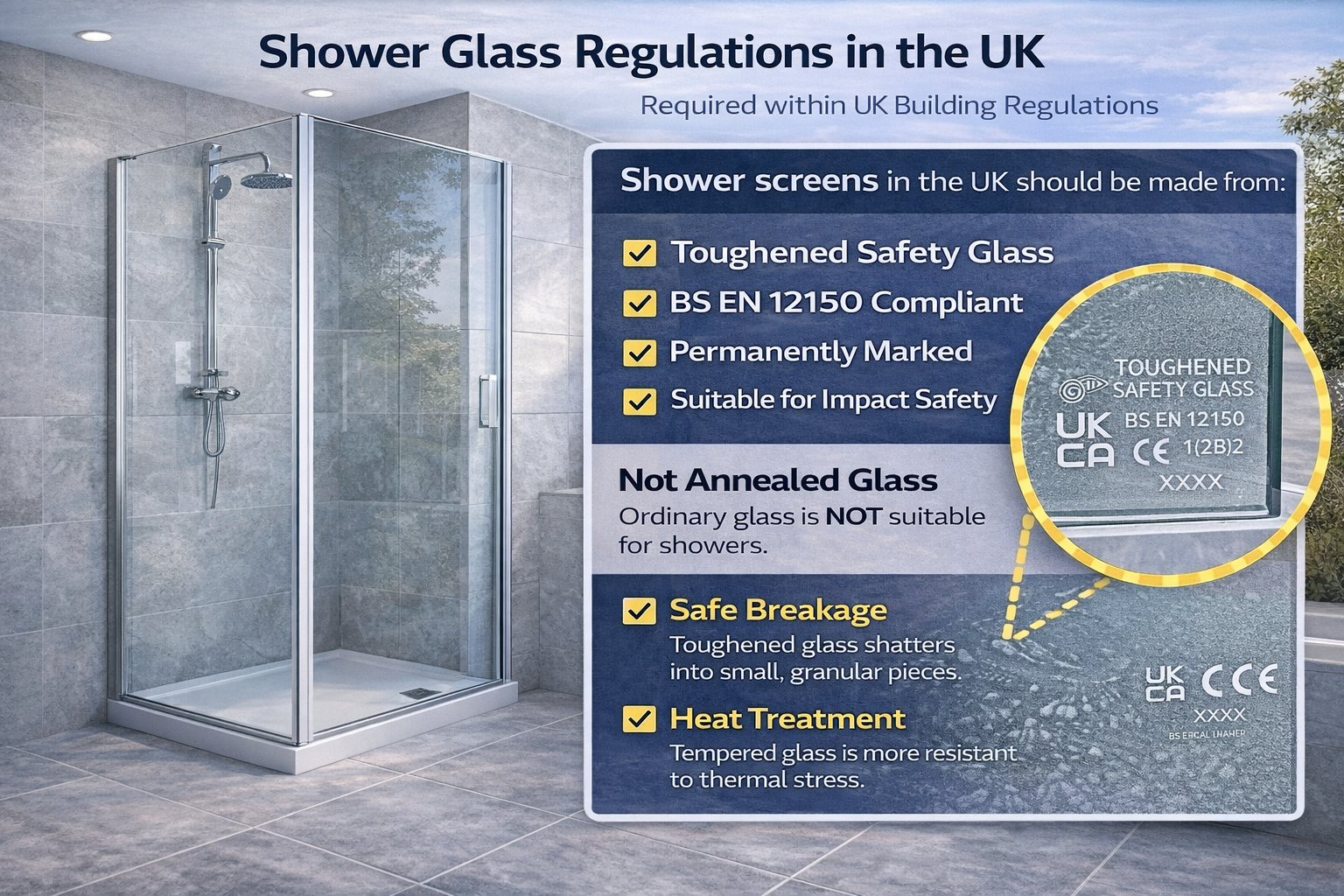
Shower screens are not dimension-triggered like doors.
However, best practice is toughened safety glass because of:
Impact risk
Thermal stress
Wet environment
12. Professional Specification Flow
Identify critical location thresholds
Confirm impact class requirement
Determine whether glazing acts as guarding
If guarding, assess fall risk and barrier height
Decide toughened vs laminated
Confirm conformity documentation
Record compliance evidence
This is defensible professional specification.
Final Conclusion
Toughened glass is essential in modern construction.
But it is not universally appropriate.
Understanding the difference between:
Impact safety
and
Fall protection
is the difference between compliant and unsafe.
When specified correctly, toughened glass is:
Safe.
Compliant.
Durable.
Architecturally clean.
When specified incorrectly, it may satisfy one regulation and fail another.
That is where professional knowledge matters.